By Kimeona Kāne (June 2026)
Kimeona Kāne (Kanaka ‘Ōiwi, Native Hawaiian) is a Kumu of Uhau Humu Pōhaku, or rock weaving: a lifeway that connects people to one another, to ‘āina, to ancestors, and to all of humanity. The following passage in ‘Ōlelo Hawaiʻi (Hawaiian) expresses a small aspect of his moʻokūʻauhau, or genealogy. By naming kin who have poured into him, Kāne aims to breathe life into and amplify those who have guided his life’s work. He moʻo wau o Ke Aliʻi Kamakana, Kamalukukui, Poʻokapu, Ke Aliʻi Kaʻahola, Kamakahalawaiokaʻahumanu, Kuliaokakauaokamehameha Hoʻokahi Mokumaia, John Kulia Mokumaia, Hattie Akaneki Mokumaia, Ida Kahaʻawinui, Daniel Bartholomew, William Lemn Sr., Ward Joseph Lemn, Annie Kaehakoni Bartholomew, Wanda Hooipo Lemn, Victor Kane, SundayAnn Kane. He kupa ʻāina au o Waimānalo, Koʻolaupoko, Oʻahualua. Ua hānau au i ka malu o Puʻu Kona me ka Līpuʻupuʻu a ka Nāulu me ka Waikupanaha.
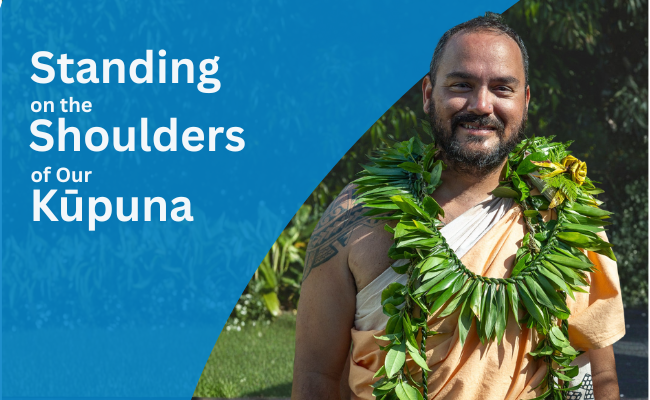
As Kanaka (Native Hawaiian), first and foremost, I have a responsibility to Hawaiʻi, to my community, and to ‘āina. We say ʻāina is land, ʻāina is air, and ʻāina is water—ʻāina is everything that feeds us and from which we receive nourishment. Much of my life is learning my kuleana, as we call it in Hawaiian; it’s the responsibility entrusted to a person to care for others, and it’s not always something that we get to choose, but it’s something we’re often born into, as I was.
Community Organizing: Kuleana as a Family Tradition
We have a long legacy of Kanaka in our family who are changemakers and “people of the people.” My mother is, and my grandmother was, a very strong leader. They brought attention to opportunities, resources, and challenges, which then inspired others to be pulled into learning with them. In my adult life, I have been called forward by various elders in the community who entrusted the kuleana to me. It’s been put on my table to eat from, and now, I’m the person privileged to provide the nourishment.
My grandmother, Wanda Hooipo Kāne, was a Lemn (family name) by birth. Her mother’s side is deeply rooted in many of the Native traditions of Hawaiʻi, including our fishing, medicinal, wellness, dance, song, and chant lifeways. She provided discipline, tough love, and genuine presence. My grandmother was one of the first influencers in my life. She raised me with the highest level of accountability and prepared me to ʻauamo, or to take on the responsibilities of communal living in the kauhale, the close-knit community in which I grew up. She taught me to think about more than just myself: that if I were to be a part of something, it would be to feed others—feeding minds through challenge and inspiration, feeding hearts with function and intentionality, feeding souls in relationships and everything else that encompasses who we are as Kanaka, as a people.
My mother is Sunday Hussey, daughter of Wanda Kane. She is someone who, even in her current battle with cancer, continues to be a beacon of inspiration, humanity, and stubborn will. Today, she’s known in our community for her resilience. This past Christmas, she was the grand marshal of our parade in Waimānalo, honored by the community for her legacy of service.
Both my grandmother and my mother lived in periods of time when being Kanaka was a shameful thing. They refused to conform to the dominant white American regime. We’re going to be authentic in our relationships because it is in the very blood and the koko of who we are as people of this place. It makes me proud to inherit this tradition of being and now live in a time where we are seeing the revitalization of so many beautiful and empowering Kanaka elements, thoughts, and functions here in Hawaiʻi. We can share what we learn with and from other Indigenous and Native folks around the world to elevate others who may be on a similar journey.
Community Organizing as Resource Management
My life is dedicated to organizing for myself, my family, and my community. My sense of responsibility, discipline, and accountability comes from thinking about this from a generational legacy of being servants to the community. It’s a privilege to work on taking our limited resource of time to develop relationships around communal opportunities and struggle over the long term. But it requires a very complex and very intimate look at relationships. Building relationships as resources requires time.
Community organizing is no different than natural resource management. Indigenous and Native communities teach us that there is no separation between humans and the natural world: We are the elemental spaces, and the elemental spaces exist with and within us. The encompassing relationships that we share at the foundational level include our songs, language, chants, and prayers, which we use to bring diverse communities together into a space that reflects the needs, hopes, and dreams of our communities.
For six years now, I’ve also been the Chair of the Waimānalo Neighborhood Board—a county-level program that helps to connect government agencies with the Waimānalo community. I’ve facilitated loving and difficult conversations to build better relationships with these agencies, identifying what types of resources we might pursue as a community for the community.
Being the Chair came out of necessity, not any interest in politics. We saw the gaps in resources in our rural, predominantly Kanaka community and looked for Kanaka leadership to be included in decision-making processes. Some of the Hawaiian elders in my community looked for someone to be a “sponge” in those places, and I chose to serve in this way—to be present and translate what I learned back to our community, ensuring that we would always have authentic representation.
Uhau Humu Pōhaku: A Foundation Laid by Kumu
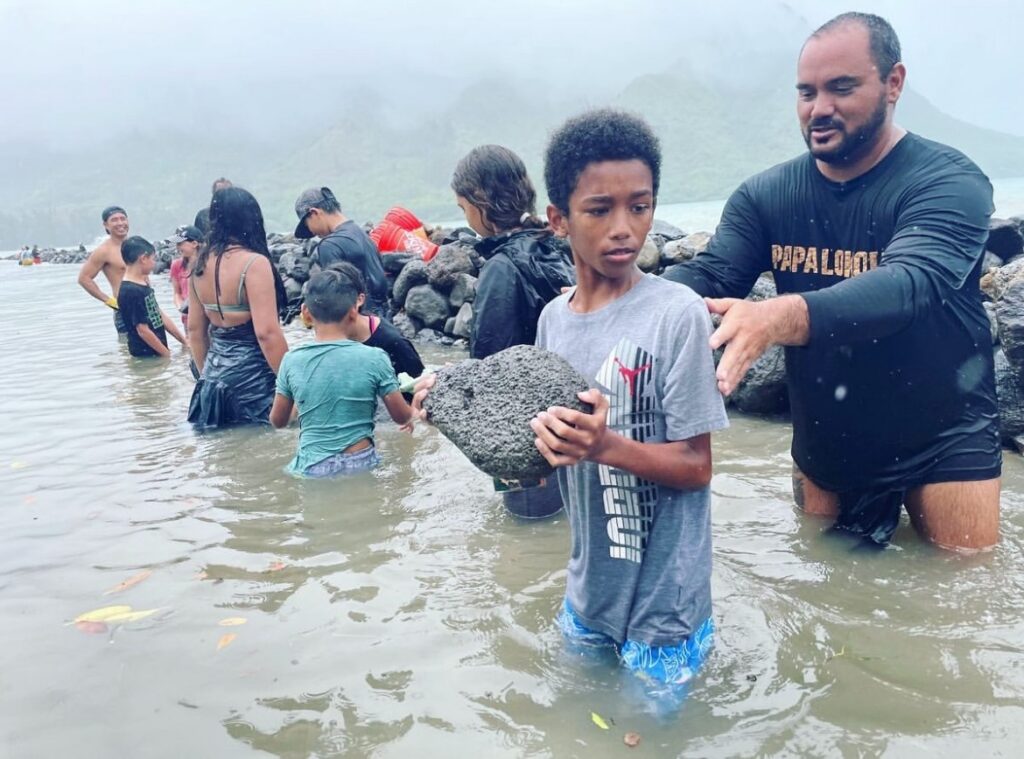
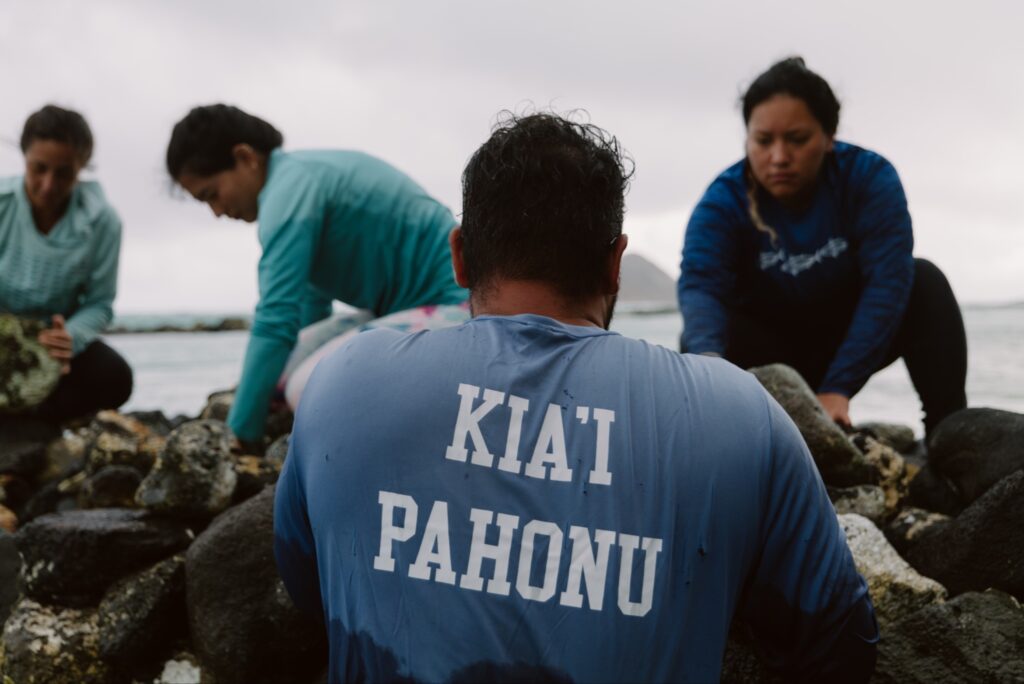
In uhau humu pōhaku, uhau means “to set in patterns next to each other,” humu is “to weave,” and pōhaku is “stone.” Uhau humu pōhaku, or rock weaving (also more widely known as dry stack masonry) isn’t just grabbing rocks, sticking them into a pile to make a structure. It is an intentional and very intimate act of relating to the very essence of who we are as Kanaka. We construct stone creations in ways that allow them to live in place for generations of time.
A Kumu is someone responsible for preserving our traditions and educating others about them. My Kumu of uhau humu pōhaku is Kinohi Fukumitsu of Waimānalo. Kumu Kinohi is a mentor and pillar of my cultural identity who bends boundaries in beautiful ways, reminding me of my kuleana (responsibility, privilege) of service to our people and the survival of our lifeways. As a haumana (student) of Kumu Kinohi, I strive to extend her teachings through rock and through “building builders” not only of rock walls but of communities, too.
In our tradition, we don’t use a hammer or chisel. We also don’t use a physical binder like mortar or concrete to build our walls. We don’t deface or desecrate rock because rock is a kupuna to us. Our kūpuna—our ancestors and elders—are buried within the very ground and within the very pōhaku that we stand on. When we transition, we are put forth into the earth, and our life energies are absorbed deep within the Pele, and when she erupts, our kūpuna are birthed back into the world as rock that we then uhau and humu.
This deeply personal relationship to rock is implemented into almost every single aspect of our identity as cultural people. Our rocks give birth to other rocks. Kanaka were born on rock. We built homes upon foundations of rock. The essence of the food we eat in our hale, our homes, includes rock. The water we drink from is purified through rock aquifers. The clothes we made back in the day, and the materials that we utilize for spirituality and healing, all included rock. Rock today still serves in many ways of our lives as it did historically.
Through rock weaving, we move ourselves through the intimacies of relationships to our natural world. In today’s time, as taught to me by my Kumu, I am privileged and humbled to be called forth to construct food systems that nurture the very stomachs of our people in real time, but also to nurture the inspirational moments of their lives that will allow them to dream and to be a part of larger systems that will feed people—not just literally, but spiritually, emotionally and mentally.
I have also been entrusted to preserve our ʻiwi kūpuna (bones of Hawaiian ancestors), which are sometimes impacted either through human behavior, erosion, or climate change. I’m now a part of a community of practitioners who have the kuleana to respond to any threats to iwi kūpuna and to ensure that the integrity of the burials and the families that they represent are forever maintained to the highest degree. This is a lifelong commitment to preservation, a reminder that we are and always will be.
I have also recently begun my journey as a haumana of ulana ʻieʻie (weaving of ‘ieʻie, or Freycinetia arborea, an endemic woody branchy climber) through my Kumu, Kumulāʻau and Haunani Sing. They have provided access for me to learn and allowed me to teach this Kanaka tradition of basketry within our communities and within our ecosystems. Essentially, we’re trying to rediscover our relationship to and perpetuate this critically important form of basketry and weaving here in the islands. This tradition weaves us back to the elemental world, a place we have sadly ventured far from. This has elevated my life of service in great ways.
Challenging Colonial Spaces of Teaching and Learning
The privilege we have as kumu and haumāna are not just for a semester but a lifetime. This relationship of learning is a lifelong commitment to often uncomfortable and meaningful learning. Haumāna embark on a path of cultural learnings that are important kahua (foundations) for us to create change within ourselves and our larger communities.
Ethan Chang, a professor at the University of Hawaiʻi, is one of several dozen haumāna I currently teach and serve. We have built considerable resources around our exchanges of thought, humbly centering the questions, “How do we serve in better ways? How can we be in better relationship?” That has led us to explore some of the darker realities around systems of Pre-K–12 and higher education. Why have Hawaiʻi schools and universities neglected Kanaka people for so many, many years? Why have they asserted that their intellectual status is greater than ours? We’ve been asking very difficult questions of each other, having beautiful, intimate conversations. I want to honor this reciprocation, that is, the way I learn from him and also his students, who challenge and learn from me in the most respectful ways. Our conversations are not arguments or disruptions; they happen in ways that acknowledge our shared learnings. Through this process, Ethan has inspired me to be more involved in transforming our current western or colonial systems of learning.
I actively challenge the major institutions here, including the University of Hawaiʻi, questioning how much they contribute to, not extract from, our community. I’ve seen firsthand university researchers come into and take from my community without meaningful reciprocation. They got the credit, recognition, and funding, while the people who contributed were never contacted again. Additionally, there’s a paradigm of success that requires going through the hula hoops of institutionalized, or so-called “academic” learning.
At first, I was fired up to call out institutions in any way, shape, or form when I felt that their behavior wasn’t in sync with honoring our community and its cultural knowledge. Over time, my mindset evolved from the negative—I’m going to fight them—to nurturing—I’m going to teach them. I feel much fuller in the ways in which I’ve been taught, nurtured, trained, and now contribute, holistically, to the well-being of my community. I now invite people to come and learn about our culture and to participate in meaningful and intentional service work with us.
Kāhea: A Call to Action and Functional Living
Kāhea is a beautiful and unique form of self-organizing. Receivers of a kāhea are pulled into a thought process that says, “Okay, I’m being asked to do something.” In doing this intersectional work regularly, we know exactly what responsibility we will fulfill. We know how we can contribute and what we can offer. People who are able to answer a kāhea, just do. For example, if we have a gathering in Waimānalo, we’ll have mahiʻai (farmers) offer from their farms and gardens; lawaiʻa (fishers) offer from the ocean; and kahu (hosts of spiritual practice) guide our ceremony as their contribution and answer to the kāhea.
Because of this, one’s ability to fall into their place of function, I don’t consciously acknowledge it as organizing. Kalani Kalima, a Native son of Waimānalo, shares about maʻa, paʻa, laʻa. Firstly, uncomfortable things become more comfortable—they become maʻa; we have some familiarity or knowledge about a topic. When we practice it and grow in our comfort, it becomes paʻa. We say, “We’ve got it; we understand how to do it; we are excelling at doing it.” Finally, it becomes laʻa, sanctified and a function of being—something that happens organically and recognizes our highest level of commitment, referring to everything that we honor, live, and breathe, including organizing. There are various interpretations of these concepts, and they all point to us being intentional about the things we do. Intersectional organizing emerges in the various ways that we show up in community, even though I don’t specifically refer to it as that.
When we organize an event or rally, we ask the questions, “How are we going to feed all these people? Where are these people going to use the bathroom?” We don’t forget those two very important things. That’s what I mean when I say people need to have a keen understanding of what their kuleana is to the communal setting, because care for our kūpuna and our keiki, the elders and the children, is of the utmost importance. If we’re going to call our community forward, we must first think of the care and safety of our elders and young ones. They are paramount because it is often our elders who will set the pace and the tone for us as mākua, as adults. We might have the physical strength and readiness, but it is often our elders who lead us forward in very beautiful, humble, and sometimes behind-the-scenes ways.
In Hawaiʻi, the term “activist” has put Native people in a very negative light. The image of an activist may have been one of an “ignorant” Kanaka, angry and mad at the world. Now, many of our people are moving into a space where they can speak fluidly through emotion, hurt, pain, and all the evil things, but still offer inspirational thoughts, actions, and responses that we want to see. We’re seeing these expressions in many beautiful ways—through the community-led responses to the Lahaina fires or the invasion of Little Fire Ants or Coconut Rhinoceros Beetles, for example. The collective mind is starting to weave itself together in ways that will support Hawaiʻi’s long-term stability, offering an opportunity for communities to thrive.
Setting Wildfires: Weaving Intergenerational Solidarities through Social Media
We probably don’t recognize enough the power of social media to bring people together. Today, it takes just a nanosecond to send an invitation that is received almost immediately. Social media plays a big role in how we see communities organized around particular topics of solidarity. It’s one of the easiest ways we learn about things happening globally and even locally. We have access to knowledge now that we didn’t have access to before, and the pace at which people respond to these things has changed.
Certain parts of our culture have been shared on particular platforms, received by someone else, and used in a way that is inappropriate—theft, really. Without guidelines for responsible use, this misinformation moves through communities as quickly as a wildfire. I choose to be careful when sharing cultural knowledge on larger platforms, not just because of the fear that it will be misused, but because of my distrust of people who may not uphold the integrity of the knowledge I share, in the ways I have learned it, from the voices of those who taught it to me. These cultural wildfires can be dangerous.
However, some cultures set controlled wildfires as cultural clearings for the purpose of bringing a particular ecosystem back to life. I choose to utilize social media in part to reach certain groups of people. This access has aided us in weaving together a multi-generational movement, not just at the lead of our elders, but at the thrust of our young people who now stand shoulder to shoulder with them.
On Mauna Kea, where many protested the construction of a large telescope on ancestral lands, our kupuna set the pace: elders rallied on the front lines and commanded the respect of everyone present. It was such a beautiful, inspiring moment to have them sit upon this sacred mountain and to be the first ones arrested for protecting it. However, people thought, “Why would we expose our young people to such violent, traumatizing experiences?” It’s because our young ones are called forth to be there, to bear witness, to learn, to see, and to feel because they will set the pace for what is going to be. They are the ancestors.
Puʻuhonua: Safe Spaces for Returning to our Humanity
In uhau humu pōhaku we recognize that anywhere we build, restore, or construct, two things must happen: One, we must be able to feed it; and two, it must be a puʻuhonua, a safe space and a refuge for people to experience life and return to their fullest humanity.
First, what we’re talking about is food. If we rebuild the loko iʻa (fishpond), the ecology finds itself in balance and in rhythm, and then, the fish will return. But the fish don’t just return immediately. It is the return of fresh water through understood pathways, like our loʻi (taro fields), where water flows into from streams and springs, then back out, returning to the stream, which leads to the ocean, where it mixes and creates the foundation for our microscopic life. In this way, the restoration of our rock walls brings with it the restoration of all the interconnectedness of life vital to loko iʻa.
The loko teaches us that when we’re in safe spaces, we can feed each other in ways that we might not be able to be fed outside of that. As humans, we are elements of a space connected to elements broader than us. So, these loko iʻa become puʻuhonua not only for fish, but for people. They are inclusive spaces, and when built with intention, they call forth. That’s one of the designs specific to fishponds, as my Kumu taught me: If you build it, they will come. If we want to see our people thrive, these systems must be reinstalled.
In our hana, we spend a significant amount of our time in study of ourselves. How do we react to a challenge? How do we react to the clouds gathering? How do we react to learning a different pule or oli? In my role as a Kumu, I have a commitment to each individual in the fullness of their being, not just when they are with me, but also when they’re not with me. The human relationships that we have established mean that we are genealogically attached to each other. Everywhere we go from this point on, I and they will have this synchronicity in how we show up, how we think, how we move into the work, how we respect and respond to the work, and then how we provide this invitation for others to join into that work.
At the end of the day, this work is about returning to our humanity. One of my Kumu simply says, “How do we just be good f–king human beings?” That is a very simple and powerful message of what it is that we value and strive to cultivate in our puʻuhonua. We work on the elementals of our bodies and our minds and our spirits. We live in the authenticity that some places naturally are meant to quell, to put down. We reflect on the various ways that relationships show up and challenge our very being, challenge our very sense of contribution, and challenge the very entity that we find ourselves identifying with and for. We must hoʻomau.
Huli: The Turning
Up until the 1980s, it was essentially illegal to speak Hawaiian in many places throughout Hawaiʻi, including schools. That’s crazy to me—that it was illegal, here in Hawaiʻi, to speak our language in public spaces like these. This is erasure. Today, the revitalization of our language has exploded within both Kanaka and non-Natives who have committed themselves in allyship to help hold space, not fill space, for our people to return. People throughout generations have used their positions of wealth and privilege to ensure that, at the end of the day, they would be able to vacate that space for a Kanaka to lead when the time is right. Stories of this happening in small doses have continued to garner strength.
We have examples of full cross-island and cross-Pacific solidarity, where we have collaborations that are reweaving themselves together. At the end of the day, humanity is one of the most defining parts of who we are; it is not bound by anything that we physically see. It is a beautiful time of challenge. I’m not going to lie: we’re not in easy times or spaces right now, but when can we say we ever were? Every kupuna that has come before us has lived through challenges that we may never experience, and they persevered then so that we might today.
Recently, we started to document our traditions and our histories through the voices of our kūpuna. We are actively interviewing our cultural resources, our cultural knowledge holders and keepers, our kumu, and our elders. We’re doing that as a way to ensure that the learning and the teaching do not die with them.
I believe we are witnessing a turning point that we are directly creating. We use the term huli, which means “to turn,” “to flip this all around,” and “what goes up will come down; what is down will rise up.” I will leave you with the powerful prophecy chant of Kapihe, from many generations ago, that speaks to these ideas:
E iho ana ʻo luna
Those things that are above will fall
E piʻi ana ʻo lalo
Those things that are below will rise
E hui ana na mōku
All of the people, all of the islands, all of the communities will band together
E kū ana ka paia
And the foundation, the kāhua, will reset
❖
Credits for various photos used throughout this essay: Kaohua Lucas (p.1); Cody Lang Creative, courtesy of KUA (pp. 2, 8), Josiah Patterson/Flux Hawaiʻi.