By Todd Warren (March 2026)
Todd Warren serves as a Statewide Campaign Strategist for Down Home North Carolina, an organization building power with poor and working-class people across the state’s small towns and rural communities through campaigns on healthcare, public education, and climate justice. This essay comes from an interview conducted with Todd in the Winter of 2024.
I grew up in a well-to-do, white family in Summerville, South Carolina. My father was an orthopedic surgeon, my mother a nurse, and by any measure, my childhood was privileged and secure.
The summer before my senior year of high school, I joined a church mission trip to Reynosa, Mexico, near the Texas border. We built houses and community centers in the border colonias. Some of these neighborhoods were built on top of dumps where garbage came out of the ground after every rain. Families lived in intense poverty in homes cobbled together from pallets and other found materials. I returned the following summer as a trip lead working alongside Mexican foremen teaching youth groups how to mix concrete and tie re-bar. I also helped bury an infant that summer. She had died of diarrhea due lack of clean drinking water. The way I understood the world was rapidly shifting.
I returned as a student to Guilford College unable to shake what I’d witnessed. Through my coursework, I began to understand the structural forces behind such suffering. Courses like “Nonviolence in Theory and Practice” introduced me to Gandhi and King, reframing poverty not as an unfortunate circumstance but as the inevitable outcome of racialized economic systems.
My paradigm shifted: we could never build enough houses through volunteerism and charity to solve housing insecurity. This seed of a concept grew later into an understanding that we need to build power to change harmful systems.
In the spring of 1996, my senior year at Guilford, I joined the K-Mart workers’ fight for better wages, working conditions, and the right to unionize. Greensboro was home to a K-Mart distribution center, one of thirteen on the East Coast. This one was unique in that they employed predominantly Black workers at wages lower than the other twelve facilities. Working conditions were deplorable: no air conditioning and workers routinely had to walk to the adjacent Wendy’s just to access bathrooms.conditions were deplorable: no air conditioning and workers routinely had to walk to the adjacent Wendy’s just to access bathrooms.
Led by the late Rev. Nelson Johnson, Black ministers formed the Pulpit Forum to support these workers, partnering with the union UNITE (now UNITE HERE). I joined what became my first experience with direct action, the kind I’d read about in textbooks. After months of civil disobedience, workers held a sit-in disrupting a high-profile Greensboro golf tournament filled with elite decisionmakers, forcing K-Mart to negotiate out of public embarrassment. The K-Mart workers and the Pulpit Forum won higher wages, improved conditions, and union rights. Kmart eventually shuttered, but UNITE HERE and the Reverend Johnson’s Beloved Community Center endured as sites for organizing.
This campaign sparked something inside of me that I am still learning about to this day: campaigns must address people’s immediate needs, and even when we win, we must go further to dismantle and transform the systems reinforcing racialized oppression. To do that, we need power, which we build through organizing.
Public Schools: From Organizing to Teaching and Back to Organizing
The K-Mart campaign was my entry point into years of multiracial community organizing. In and out of the Beloved Community Center and the Racial Justice Network, where I observed and learned from veteran Greensboro organizers like Reverend Johnson, Joyce Johnson, Willena Cannon, and Ervin Brisbon, I worked on multiple actions and campaigns alongside Black and white organizers. We focused on police brutality, mass incarceration, housing insecurity, and public education. Somewhere in the midst of all that, I found teaching and eventually made my way back to unions – this time as a member.
In 2013, funding and working conditions for public schools deteriorated sharply. The Tea Party wave that began in 2010 had delivered to North Carolina a legislature with a Republican supermajority that launched a shock-and-awe assault on the public sector: healthcare cuts, attacks on reproductive rights, and gutted public education funding arrived weekly.
The Moral Monday movement, which was challenging state government through protests and civil disobedience, was a natural starting point for conversations with other teachers on Halifax Mall outside the General Assembly. I connected with union members of the North Carolina Association of Educators (NCAE) who wanted change. Together, we formed Organize 2020, the racial and social justice caucus of the NCAE.
Over that decade, I was very active with the caucus and eventually was elected as the local union president in Guilford County in 2017. We were working to rebuild what it meant to be a fighting union in the South and joined the “Red for Ed” strike wave that swept from West Virginia across the nation, with the North Carolina movement leading statewide walkouts in 2018 and 2019. Then came the pandemic and, with it, new rounds of attacks on public education.
As my union presidency ended, a new wave from the political right emerged: anti-mask, anti-CRT fervor that birthed extremist groups like Moms for Liberty. In the fall of 2021, I was experimenting with mobilization strategies to get public education supporters to turn out to school board meetings. I was hosting Zoom sessions teaching effective public comment and peer recruitment.
A friend who worked at Down Home North Carolina came on our calls to deliver political education, helping people understand the coordinated strategy behind the vitriol erupting at board meetings: anti-CRT, anti-LGBTQ rhetoric, the book bans, and “groomer” accusations. We helped people recognize these as calculated attempts to activate racist and transphobic fears, weaponizing the idea that “woke public schools” were a serious threat to (white) children. We knew this bore no resemblance to people’s actual experiences with schools, but we had to counter it through direct, sustained conversation and turnout to school board meetings. That work led me to take a job with Down Home to do rural organizing full time starting in 2022.
Public School Strong: Defend and Transform
Public education remains our most vital democratic institution. North Carolina’s 115 districts serve 1.2 million students and employ 110,000 staff. Public schooling is among the last majority-serving institutions that we have held onto as a society.
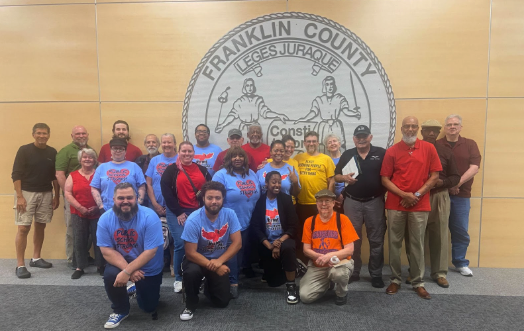
Public schools can and do deliver incredible opportunities, but chronic understaffing makes addressing systemic inequities harder to achieve every year. When we help people analyze county budgets and organize for local needs, they learn about structural inequities. We run small, issue-based county campaigns not just because they matter, but because they teach people the path to winning improvements now and building power for the long haul.
Public schools, we believe, should be governed democratically through elected boards that communities can hold accountable. The myth that private or charter schools serve students better collapses under scrutiny: these institutions consistently lack transparency, services, and redress for students with disabilities, and systemic discrimination is cleverly hidden behind marketing rhetoric.
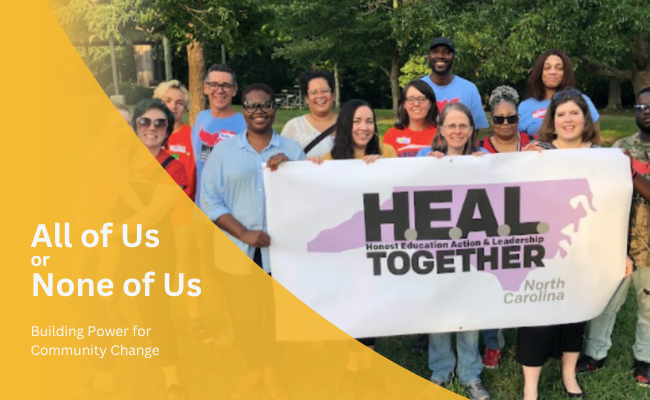
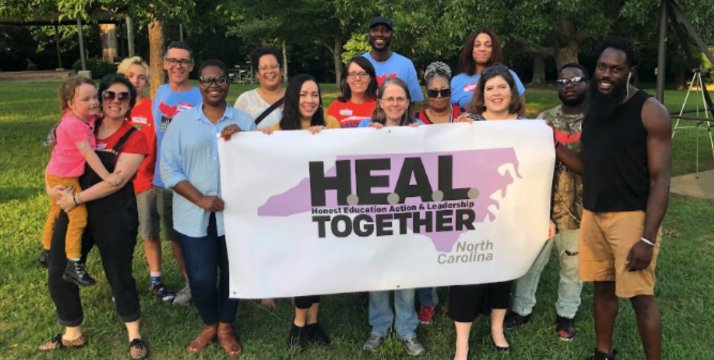
Starting in 2022, Down Home partnered with organizations like the Education Justice Alliance and the Center for Racial Equity in Education (CREED) to anchor H.E.A.L. Together North Carolina.
We knew that to win better public schools we needed to address a critical gap: we needed deeper multiracial organizing across the state rooted in local teams with the skills to win. Previous education organizing efforts were strong in places, but siloed and disconnected from others. As a coalition, we now build volunteer leaders’ skills across racial lines, county by county focusing on some basics: meeting facilitation, public comment, relational organizing, recruitment, and local campaigning. We’re working with people as they confront what building power means, stepping through fear to actually contest for winning the schools our students deserve.
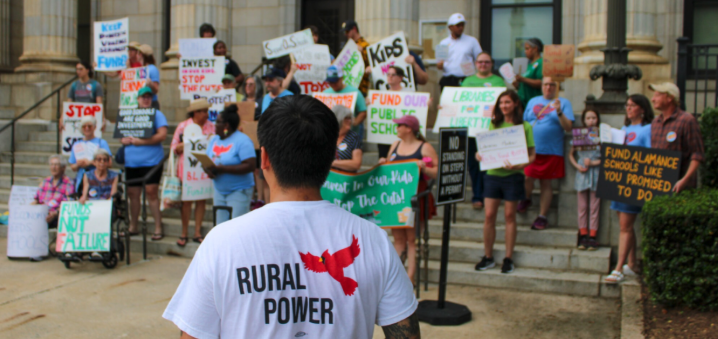
We’re expanding our Public School Strong campaign, which centers on turning people out to school board meetings with members committed to honest, equitable, safe, and fully funded education. Active in over 70 of 100 NC counties, our message is simple: public education is a core community resource for all students, regardless of their zip-code.
We’re building Public School Strong as a model for sustained school board participation, privatization resistance, and keeping public dollars in public schools all while amplifying community voices. To be able to transform public education, we must first defend it and our right to govern it collectively. These schools belong to us, even when they fall short of their promise. We’ll never realize education’s transformative, liberatory potential by continuing down the path to privatization.
Moving Beyond Buzzwords Toward Practical Organizing
I entered this work around age 20, in the mid-to-late 1990s. It’s hard to convey how desolate the organizing landscape was then. Decades prior, movement leaders had been expelled, fired, or killed; their organizations systematically dismantled. I am Gen X and prior to Occupy Wall Street and Black Lives Matter, we had never witnessed mass movements, much less successful ones. That absence of collective power and uprooting of organizing traditions shaped what people believed was (and wasn’t) possible and left us with major skill gaps for how to make change.
The early 2000s were messy. It was natural for young white organizers to grapple with what anti-racist work meant for us, but without a clear framework and organizing skills, difficult conversations eventually became what we know now as “call-out culture.” Well-intentioned but often damaging, we ran headlong into power structures we didn’t understand or couldn’t access and instead too often took it out on each other.
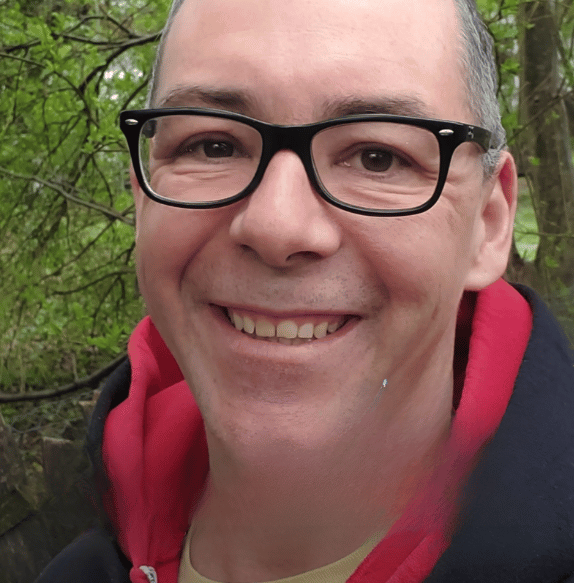
I come to organizing now as a 51-year-old-dad of young adult children. I feel the climate crisis as an existential threat acutely aware that we are on a ticking clock. As a former teacher, my students live in my heart alongside my own kids; their future is our collective future.
I deeply believe directly addressing anti-Black racism when it surfaces, as it did in the K-Mart campaign, is essential. Equally important is building deeply felt, majoritarian campaigns and movements that welcome people across race, class, and identity. When we trust people’s core desires and work with them with integrity and care, we grow stronger together.
A Duty to Win
I deeply believe in experimentation and risk-taking, approaching organizing as both science and art. Science in the ways we are able to test and improve our methods; art for the faith and intuition required to navigate the unknown. Frequently it is essential we act on instinct rather than freeze in times of unsurety. Those instincts are honed by doing the work and being brave enough to take risks, make mistakes, and build upon the lessons from each campaign.
Since 2023, Down Home has run an annual “Organizing Bootcamp” with our working-class members from counties across North Carolina. After the training they return home to run campaigns to win improvement in their own communities that put them in newspapers, require public comment, and demand time away from work. Those are risks they are taking. With every campaign we are asking them to step into leadership and can’t guarantee they won’t face local press attacks or employer retaliation. But without everyday people taking risks like these, nothing changes, and we keep losing.
The crises engulfing our country: climate collapse, education defunding, rocketing healthcare cost, etc., all demand solutions at scale. We’ve been systematically diverted from the majoritarian fights of the Civil Rights and labor movements into siloed, small-scale battles over the past three decades. That won’t achieve the scope we need, because our enemies are currently better organized, faster, and better funded. But we overwhelmingly outnumber them and they know it. We need expansive vision rooted in real leaders that regularly test their work on the ground.
I’m still on my organizing journey and grateful for learning along the way. Jane McAlevey’s structure-based organizing taught me that we must train people from the ground up while maintaining their agency and creating opportunities to test their power. Two quotes guide everything I do: Assata Shakur said, “We have a duty to win.” When we’re not winning, we’re not doing the right thing and need to try again. Marshall Ganz taught us that leadership is “accepting responsibility to help others achieve shared purpose in the face of uncertainty.” Our conditions today are nothing if not uncertain. If we’re truly doing our work, communities can win what we want: affordable housing, equitable education, healthcare, and a planet that sustains us all.
All of Us or None of Us: Building a Movement for Everyone
With Down Home NC, along with working people and partners across the state, we are helping lead a revival of Southern organizing. Addressing the deeply oppressive, racialized economic systems that still grip this region is central to success not only for the South but for our country and world.
Building this strategy requires white people to understand that we’ve been sold poison: the illusion that we’ll somehow escape the ravages of white supremacy. Some of us have been given the trappings of good jobs and houses, but we’re watching them crumble – the economic opportunities of my parents’ generation are worse for me and look on track to be worse for my children. Even as someone with a lot of privilege, it is clear that this is a system rigged for the ultra-wealthy. We have an opportunity to build a world that works for all of us and it’s clearer every day: it really means all of us. No special group escapes a collapsing ecosystem unscathed.
The young people entering this movement are a source of tremendous hope; they will surpass us because they can and must. At a recent conference, I watched seventeen-year-olds present, and their organizing skills and understanding of the world vastly exceeded what I knew at their age. It gave me tremendous hope.
Ultimately, I’m fighting for self-determination for all people in all communities, regardless of zip code or identity. Living on this planet is a collective endeavor. It really will be all of us or none of us.