By Candi Brings Plenty (June 2025)
Candi Brings Plenty, who uses the pronouns they/them/she/her, is the wasicu name of the organizer telling their story in this essay. Candi is Oglala Lakota Sioux from the Titowan band and a Two-Spirit Water Protector and Land Defender. Candi was the ACLU’s first Indigenous Justice Organizer for Wyoming and the Dakotas. They led the creation of the Two-Spirit Camp at Standing Rock and continues to support Two-Spirit people across tribes in the Two-Spirit Nation.
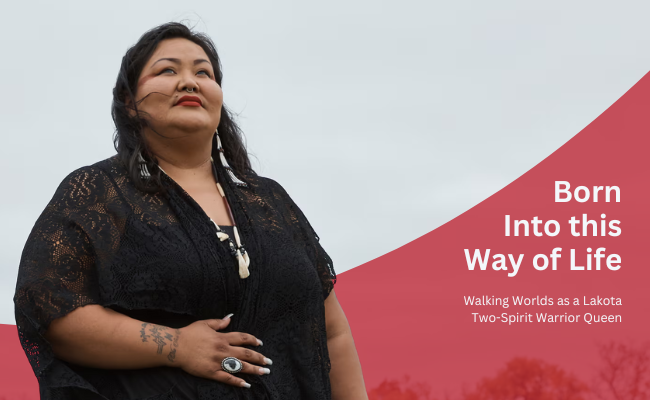
I greet you with a handshake from my heart, on this day, in this moment. My Lakota names are Wakinya Tunwanpi Iyoyanpa Win (“Bright Lightening Womxn”) and Čantè Mí Kín Yela Win (“Womxn Close To My Heart”), a name passed down through my dad’s side. I come from the Wakinyan oyate. My wasicu, colonizer name is Candi Brings Plenty. My great-great-grandfather was Brings Plenty Of Horses To His Tribe. I come from the Očhéthi Šakówiŋ territory, the land of the sacred black hills where the water is rapid.
I am a direct descendant of Crazy Horse’s band; my great-great grandfather was his whip man, the person who implemented ceremonial protocol for public gatherings. When Crazy Horse and his war party would go out, my great-great grandfather made sure that tepees like ours continued to function collectively—to work together as a tiospaye. The horse tail that serves as a whip has been carried down generations to the men in my family. My mother was part of the American Indian Movement when they occupied Alcatraz.
I like to say that I was born into this way of life. Through a colonial lens, it’s called “organizing” or “activism.” In our culture, however, it’s our obligation: it’s our responsibility to take care of the oyate, our people.
Before Anything Else, I am Oglala Lakota
Although I carry many different identities, I am Oglala Lakota first. That is my culture. Oglala is my tribe; Lakota is my dialect. In our language, we have words that don’t translate into English or fit into the colonial worldview expressed by the English language.
When we meet each other, we greet each other—like I did at the beginning of this essay. Even to this day, despite generations of historical trauma, we introduce ourselves by our names, our grandparents’ names, our parents’ names, our location, and our Lakota names, because that’s how we’re connected to Uci Maka, Mother Earth. The trees and the water, also connected to Uci Maka, are relatives we live with, not inanimate objects.
In the Oglala Lakota community, everybody is a leader, and everyone has a role. As Očhéthi Šakówiŋ, we are the seven tribes who protect the water, the families who hold leadership roles. Organizing comes very naturally to folks who are born into this culture and with indigeneity to the land, regardless of what that looks like and how they were raised through a colonial lens.
Unfortunately, colonial violence created many of the circumstances we live through today. Back home on the reservation, there are still so many folks who don’t have running water or electricity. Also, ongoing battles continue between the tribal nations and the US government. In each of these fights we protect Uci Maka, who we come from and who provides everything for us, because they are literally threatening our mother. It wasn’t hard for us to organize; it’s just a manifestation of the way we’ve been living.

The boarding school era almost demolished who we were. This was intentional by the US government which passed the 1934 Indian Reorganization (Wheeler-Howard) Act, giving plots of land to Natives only if they sent their children to boarding schools to get “civilized.” In reality, we suffered historic trauma from the people who ran these schools, including some who were Catholic priests and nuns. When my mom went to Catholic boarding school, they cut her hair. They took everything she had from her, scrubbed her, and put strange clothes on her. My mom’s never had anything since then. Our parents were raised by priests and nuns who sexually and physically abused them, and they never received authentic, healthy love.
Even though my parents and others survived the boarding school era, there’s a generational distress that hasn’t yet been healed. As Natives, we’ve been alienated from education. There’s huge distrust with the government; we’ve had to hide our children from schooling. As Indigenous people, we are actually living in a post-apocalyptic state of being. Natives don’t really vote or participate in US politics. Federal laws require the use of blood quantum to quantify if you’re Indigenous enough to enroll as a member of your tribe, like we’re dogs or horses being evaluated for our worth. This creates a slow genocide of our identities: when Natives marry or partner across tribes, the children may not qualify for membership. It’s all part of the same old plan—steal the land by stealing the children, erasing our identities generation by generation.
Chief Red Cloud, who led our people against the US army in the mid-19th century, knew that our way of living would come to an end if our children and our land were taken from us. He looked to the children in our community, the wakanyeja, which means the sacred or chosen ones. We consider children sacred because they are the last to be with our ancestors and closest to who we are today. The most important thing is that children get the education we believe they need so they can be the strongest Lakotas—not the strongest white kids, nor the strongest non-native versions of our people, but the strongest Lakotas.
My mom always talks about how I walk in both worlds. My parents tried their best to keep me very much fluent in Lakota culture and spirituality while I was the only Native American—the only student of color even—in my Rapid City, South Dakota school, 80 miles from the reservation. I was a super nerd who loved reading, got straight As, played flute and viola, and was first seat in orchestra. But at school, I experienced abuse and bullying from older girls, neglectful ignorance by some teachers when I needed help, and punishment by other teachers when I was trying to help others.
My Journey to Come Into My Two-Spirit Self
At the age of 16, I told my family that I identified as Two-Spirit. I had heard the term on the radio show Native American Calling and was like, “That’s me; that’s who I am.” How I saw myself—and wanted to be seen—changed forever at that point.
Two-Spirit people were here before First Contact, but there was no single term for us. In the United States alone, there are about 580 federally recognized tribes, each with its own language and culture. And every single culture has a word for someone on the LGBTQIA+ spectrum. In my Lakota language, for example, we have words like winkte for someone who was born basically as a transgender person and winkyan boka for a woman who lives both ways.
Women and Two-Spirit people were the backbone of our society; they were teachers, political decision makers, medicine practitioners, warriors, and much more. Part of the colonial strategy of “divide and conquer,” however, was to remove them from positions of power. That’s why, in the early nineties, our elders chose Two-Spirit as an umbrella term to reclaim the part of our shared cultural understanding that recognizes that sexual and gender identity is fluid, and to push back against its exclusion from places like written research. The term may be contemporary, but it’s what fits us.
Now, even within our LGBTQIA+ communities, we’re often erased. It’s been this way since First Contact. Because of this, I want to make sure we work toward healing historical trauma and bringing Two-Spirit people back into the circle of our tiospayes.
Founding The Two-Spirit Nation Camp at Standing Rock
That’s why I created the Two-Spirit Nation at Standing Rock—a type of space that hadn’t really been seen before. I had gotten involved with the protest to stop the construction of the Dakota Access Pipeline, or DAPL for short, after many people asked me as a descendant of Crazy Horse’s band to do so.
I asked the Elders Council at Standing Rock to have an encampment for Two-Spirit participants as part of the big camp. They agreed, and I ended up becoming part of the leadership council. We weren’t “campers,” however. We weren’t visiting, dropping off donations, taking selfies, and leaving; that’s what “weekend warriors” do. I asked our folks to give four hours of service daily to the big camp so that we’d be seen every day.
I worked to reclaim the role of Two-Spirits through this work, bridging the gap between genders and bringing back a holistic perspective that extends beyond the gender binary. Historically we are the people who would adopt children whose parents couldn’t provide, including those whose parents perished. I led workshops that helped our community understand and use their spiritual armor. It’s something we all have, no matter our ethnicity. We need it to walk in this colonial world, stand strong in this fight, and still be connected to our ancestors. It might look like wearing beadwork, shells, dentalium, or long hair with braids, for example.
I saw so much Two-Spirit amazingness happening at Standing Rock. Two-Spirit people were everywhere throughout the camp. I helped Two-Spirit people claim their identity and learn about their own culture and history. Each one of those people went back into their communities and continued that work. Since then, there’s been so much Two-Spirit visibility in tribal leadership.
It wasn’t until Standing Rock that many Two-Spirit people felt they had permission to emphasize that intersectional identity of themselves in their home communities. I told folks that the front lines are exactly where you stand, and you fight with what you have in your hands. For me, it’s my culture and my prayers in one hand, and my secrets in the other—all of the teachings and belongings that I hold dear.
At Standing Rock our opposition became fearful because they had never witnessed the power of Indigenous people calling our own traditional kinships together. It was the first time many people had witnessed, with their own eyes, what it looks like for Indigenous people to organize.
From Colonization to Current Reality: Fighting Multiple and Intersecting Invisibilities
When I first heard the term “intersectionality,” I remember being really confused. I just tried to “fake it ‘til I made it.” I told myself to Google it. It wasn’t until 2014 when, trying to still establish myself in the Portland community, I joined a communities of color roundtable and started to understand the concept more deeply.

In civic meetings, I began to ask, “Where’s the Native American folks at?” I wondered where our Native community was in everything. I then began to hold meeting organizers accountable, asserting, “This isn’t true equity, diversity, or inclusion if Indigenous people aren’t at the table. If you don’t have an Indigenous person in your leadership, how are you making informed decisions about the land that you’re working on and for?”
So I did a lot of really awesome learning, which I now use to “break it down” and fight for space to be seen. I just left an organization after I was there for almost a year because I felt they minimized the nature of Two-Spirit identity and the communities of people who belong to that. To me, that was a gigantic erasure, especially for an organization that claimed inclusion. Being Two-Spirit is tied to my essence as a Lakota. For folks to say that Two-Spiritness is merely just a type of intersectionality, I felt, was one of the cruelest erasures of my identity. Yet I feel so many folks don’t understand that.
When I came back to South Dakota, I worked for that state’s ACLU as their only registered lobbyist. I planted seeds to incorporate Two-Spirit people into law. I even won a victory: codifying that all future bills mentioning LGBTQIA+ would have to include the word “Two-Spirit.” So now, every time a legislator reads one such bill, they’ll see the word and have a tiny internal conversation where they ask themselves, “What is Two-Spirit?” and do their own work to figure it out.
After the law passed, I had youth, teachers, and other folks tell me, “I was so excited,” or “You saved my life,” or “When I was recognized as Two-Spirit, I felt like I actually did belong in South Dakota.” They had been feeling the erasure too.
When it comes to talking about diversity, equality, equity, and inclusion, people don’t usually mean us. Right now, it’s such a long journey to get folks who have not really walked the path to understand the experience of a person who has been erased on their own Indigenous lands or removed from Turtle Island as an immigrant. It’s really hard to stand in the face of these DEI efforts when I know we’re still being actively erased, continuously left out of the conversations where other academic amazingness is happening.
When I went to Standing Rock, I knew I couldn’t show up as anything other than my full, authentic self. Especially being Two-Spirit and in our culture, it is not “me,” it’s “we.” Anything we choose or decide to pursue, we move forward as a community. I knew I needed to create space for other Two-Spirit people. That’s what we’re taught and that’s what I do, because if I need something, twenty other people who haven’t verbalized it yet may need it too.
Standing Rock was my opportunity to create visibility for us. It was about mending our broken circles, repairing those teepee poles that colonization and assimilation had tried to tear down. We couldn’t just tell people about who we were—we had to show them. We engaged in healing, re-education, alliance building, and following our traditional kinship protocols, recognizing that everyone has a place in this work and that we move together as one.
But our tradition is just not the way it is anymore for so many of our people. That’s definitely due to a persistent “divide and conquer” mentality coming from colonial violence. In the past, it had been conquistadors, the British, and the French. Today in the United States, it’s English language, churches and Western religions. It’s a fight against assimilation to this day.
Solidarity: Trauma, Displacement, Kinship
It took me leaving the reservation and going to Portland to really understand how deep our trauma runs. Back home, everyone’s so saturated in it that we can’t even imagine what a healthy life looks like. That’s why it’s so hard for our students who go off to college: they’re carrying all this pain, trauma, and loss with them. During the pandemic, I lost 32 people, including four ex-partners I didn’t even know had passed. It hit me hard, having to count who I still had left.
But that’s when I started to understand what real solidarity means. It’s about finding common ground, even in our struggles. In our culture, we talk about being a good relative. I guess you could compare it to what white folks or church people might call being a good neighbor; but for us, it’s law—not an option. We have obligations to our oyate, our people. Obligation sounds like a harsh word, but it’s really a love language for us.
The way I teach solidarity, especially to other Indigenous folks, is that we build kinship by finding similar disparities. That’s how we create solid ground together. My father told me, “You have to go live amongst Wasicu leaders.” Wasicu is our word for white people—it literally means “fat takers” in our language, harking back to those old photos of piles of buffalo skulls, where white people took only the best parts and left our people starving.
Doing all this public speaking really opened my eyes to how much of our story isn’t out there. There’s this huge gap in knowledge, and it’s only getting worse with the bans on critical race theory and books about our history. They’re trying to erase us from the very places where education happens. That’s why I always say, “There’s no borders on Turtle Island, and no one’s illegal on stolen land built by stolen people on the shoulders of my ancestors.” That’s what being a good relative means to me—speaking these truths.

Black folks are stolen people from stolen lands too. There’s a huge potential for solidarity there. We’re all displaced in some way—all facing white imperialism. Movements like Black Lives Matter brought attention to injustice and imprisonment. Indigenous people actually have the highest incarceration rates, but we’re often erased from that conversation too. We’re still fighting to free our American Indian Movement leader Leonard Peltier from political imprisonment; no US President has yet granted him amnesty or compassionate release.
I was invited to teach at a Zapatista women’s gathering in Mexico, but couldn’t go because I’m on an FBI watch list as an “environmental terrorist” for my leadership at Standing Rock. I’m a prisoner in this country for fighting for my own land. The Patriot Act justified bringing sheriffs to Standing Rock, claiming we were opposing the US government by protesting for our water. They’re using laws meant to fight terrorism to silence us for protecting our own land and water. It shows you how deep this system of oppression goes, and why we need to keep speaking out and building solidarity across all our communities.
I see so many communities of color getting strong by organizing within this colonial system. But for us Indigenous folks, it’s different. We’ve been living in what are essentially prisoner of war camps. My reservation, Pine Ridge, was founded originally as POW Camp #334. There are nine reservations in South Dakota, which means nine POW camps, each with their own number. That’s what “reservation” really means—reserved land to imprison Native Americans. If we stepped off that land at one time, we could be shot or taken, just like cattle. Many of our people are still afraid to leave the reservation.
We carry historical trauma in our bodies. It makes it hard for us to organize, to cross lines, and to build connections with other communities. It takes so much to move from that place of trauma to a place where you feel empowered to speak your truth. In South Dakota, it’s even harder. We’re living in a super Republican state with a transphobic governor. Out of 70 legislators, only six are Democrats. We lose every bill, every time. It’s a system designed to keep us divided and conquered.
When we go into urban areas, we can share our intergenerational trauma with Black communities, with Brown communities, and with other marginalized communities and build solidarity. Indigenous people, especially those who have been harmed the most, are saturated in their trauma. But we need to connect with communities who have organized in urban areas so we can come back stronger, together. This hasn’t been modeled for us in many of our tribal nations.
Generations Through Time: Fighting for our Wakanyeja
We’re born into this constant fight—not for a good life, but just to have a life at all. My parents have faced their share of battles and trauma through boarding schools; my girls face pressures to assimilate in their schools. We’re still fighting to reclaim our ways of life but also finding strength in our traditions and the wisdom of our ancestors.

I’m a mentor for the International Indigenous Youth Council, full of youth who initiated and led the Standing Rock movement. I’ve been teaching them how to advocate with their tribal councils. They’ve become really powerful, outspoken young warriors.When they talk about the injustices of boarding schools and our current education system, I hear their fear, hurt, and pain. Their trauma is still so present and overwhelming.I call myself a Two-Spirit Warrior Queen. I am fighting for our wakanyeja, the children, those who come after us. I am fighting so they don’t have to walk in fear of being themselves. I am fighting so that they can stand in their own individual imperfection of being exactly who they are.